Skip to content

Research evidence

How Much Can a Mapped Line Tell Us?

A completed, reproducible experiment against known shapes. It tests local curvature estimation through the same geographic-coordinate preparation used by the App.

  • Synthetic reference
  • Fixed held-out evaluation

F03 · Archived Model 3.2 experiment · Menger, 25 m

Error Increased Across the Four Parameter Steps

Root mean squared curvature error (10⁻³ m⁻¹)

2 m0.0354
5 m0.1955
10 m0.4283
20 m2.7957
Exact Values and Denominators
Equal-weight average of the six curve mean squared errors, followed by the square root
Parameter StepRMSE (m⁻¹)Available / Requested
2 m0.000035375014328 / 54
5 m0.00019553831128 / 54
10 m0.00042830303528 / 54
20 m0.0027957221228 / 54
Each curve carries equal weight. The same 28 of 54 positions were supported at each spacing. The remaining 26 lacked a full centred window. The parameter step differs from distance along the curve for the sine and parabola. Study record
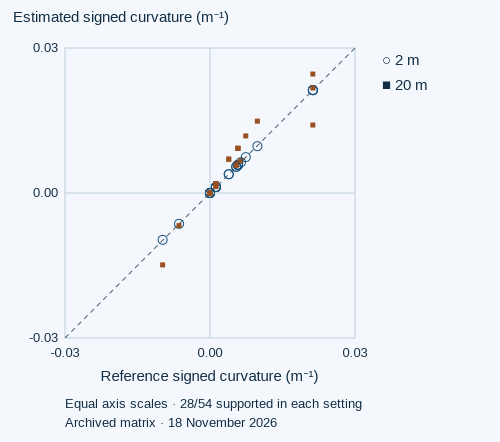
F05 · Archived Estimates Versus Reference CurvaturePaired 2 m and 20 m estimates plotted against known signed curvature on equal scales.

Twenty-eight of 54 positions were supported at each spacing. The points on a curve share geometry. Exact measurements and unavailable positions (CSV) · Metadata · Vector figure

Compare all six reference shapes

Completed experiment · 18 November 2026

When Did the Estimator Return a Value?

All 13 available clean-circle estimates were within 5% of known curvature. The other 2 requests lacked support. The stress set also includes noise, sparse inputs and boundaries.

Clean-circle interiors13 / 15
Full stress set338 / 756
Share of requested estimates available. These tests use synthetic shapes with known geometry.

The Experiment

The protocol and scientific source were frozen before either split ran. No method was tuned or promoted after seeing the held-out results.

Reference and Input Path

Straight lines, three circle radii, a reversing sine curve and a smooth parabola supply closed-form curvature. Independently generated coordinates are placed on the WGS84 ellipsoid, then passed through production cleaning, projection and stationing.

Development and held-out sets use different curved-shape parameters, noise seeds, locations and orientations. Each contains 84 fixtures, nine dependent stations per fixture and five fixed method settings: 3,780 result cells per split.
What “Held-Out” Means Here

The earlier planar study was already known. This extension reserved new parameters and seeds before execution; its outputs did not guide a fitting choice. It is a parameter holdout within familiar shape families, not an independent researcher’s validation.

All requested cells are retained, including unavailable results. Errors are summarised within each fixture first. Neither interpolated stations nor neighbouring samples count as independent roads.

Results, Including Unavailable Checks

Held-out set only. Relative errors exclude zero or near-zero reference curvature and unavailable estimates. Tail values are P95 of fixture medians, not confidence bounds.
MethodAvailable / requestedMedian relative errorP95 relative error
Menger, 25 m (Model 3.2)338 / 75612.00%165.6%
Raw three-point baseline239 / 7564.07%13836.7%
Polynomial, 25 m233 / 7560.55%347.9%
Polynomial, 35 m252 / 7560.70%154.5%
Polynomial, 75 m160 / 7562.90%24.0%

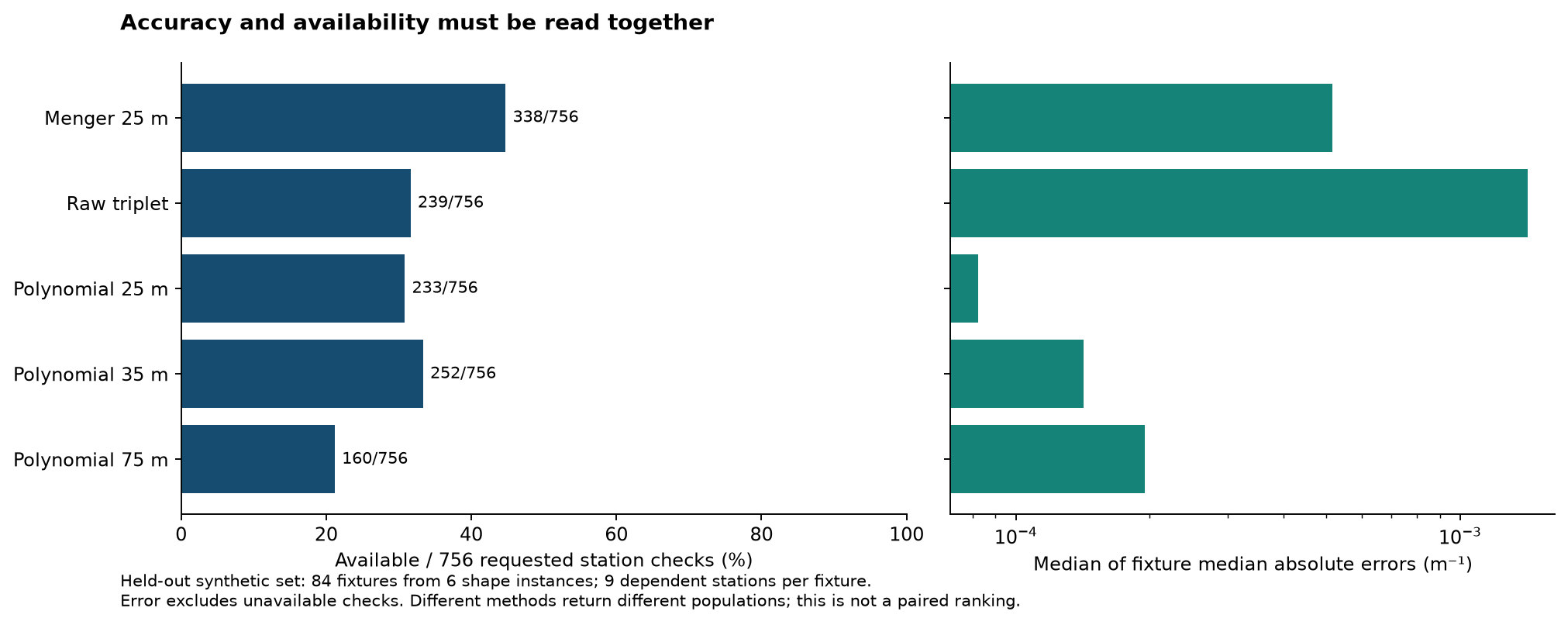
A lower median error does not establish a better overall method. Each method accepts a different subset, and tail errors can be large. The 75-metre polynomial span reduces some perturbation effects but returns only 160 of 756 requested results. It does not replace Model 3.2.

Post-hoc comparison · absolute curvature error

How Large Was the Error on Shared Stations?

● Menger baseline◇ Candidate
Raw triplet239 stations · 55 fixtures
● 0.645   ◇ 1.419 km⁻¹
Polynomial · 25 m233 stations · 54 fixtures
● 0.319   ◇ 0.083 km⁻¹
Polynomial · 35 m252 stations · 54 fixtures
● 0.319   ◇ 0.142 km⁻¹
Polynomial · 75 m160 stations · 60 fixtures
● 0.277   ◇ 0.197 km⁻¹

Shared scale 0 to 1.5 km⁻¹ · median of fixture-median absolute errors · lower is closer.

Within each row, both methods used the same stations. The common set changes between rows. The differences describe these fixtures and carry no confidence interval. Study provenance

Error and Coverage

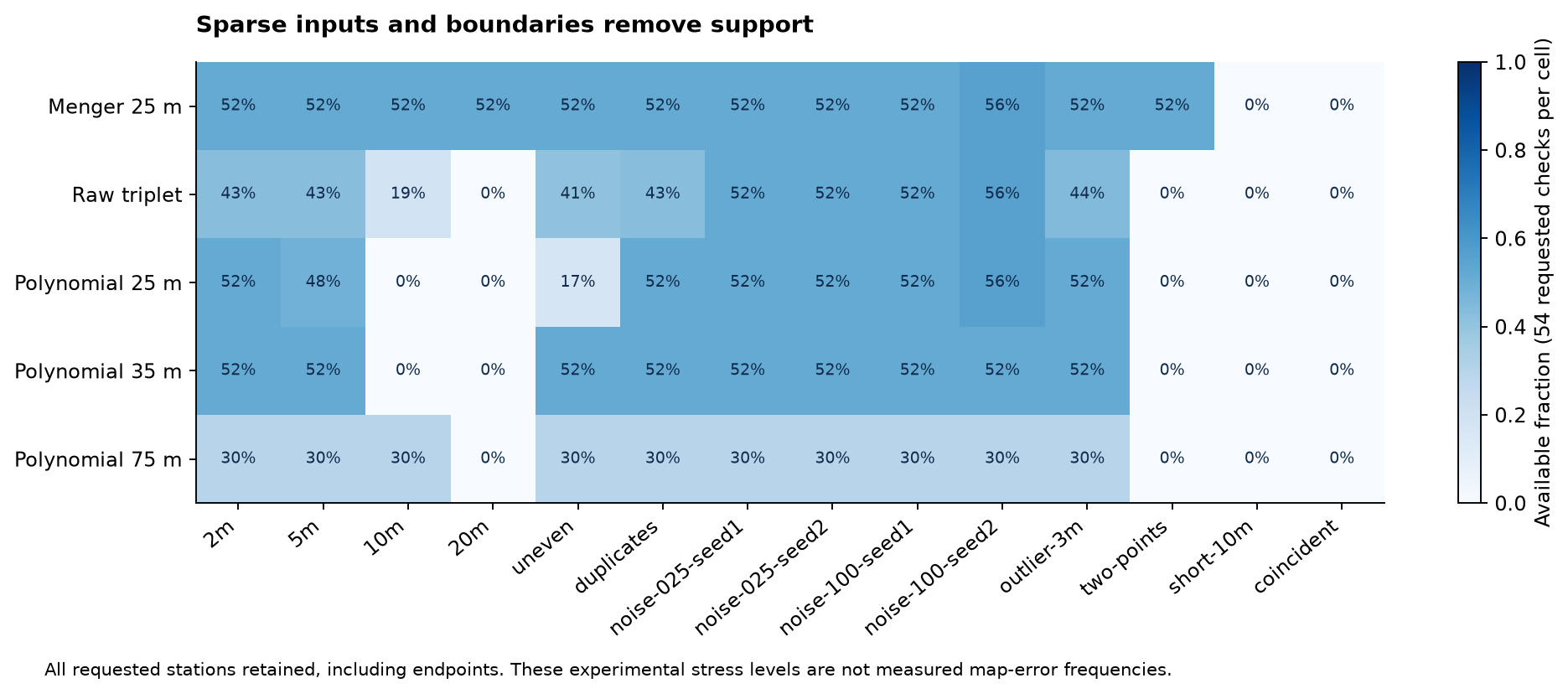
Availability ranges from 21.2% to 44.7% across the five fixed method settings. Error summaries use available results, so they must not be read as a like-for-like ranking.
Open full-size figure

Where Support Is Lost

Each cell includes 54 requested checks from six shape instances. Endpoints, short fragments and coincident inputs remain in the denominator. Interpolation is not a new observation.
Open full-size figure

Synthetic experiment · Model 3.2 · 25 m support

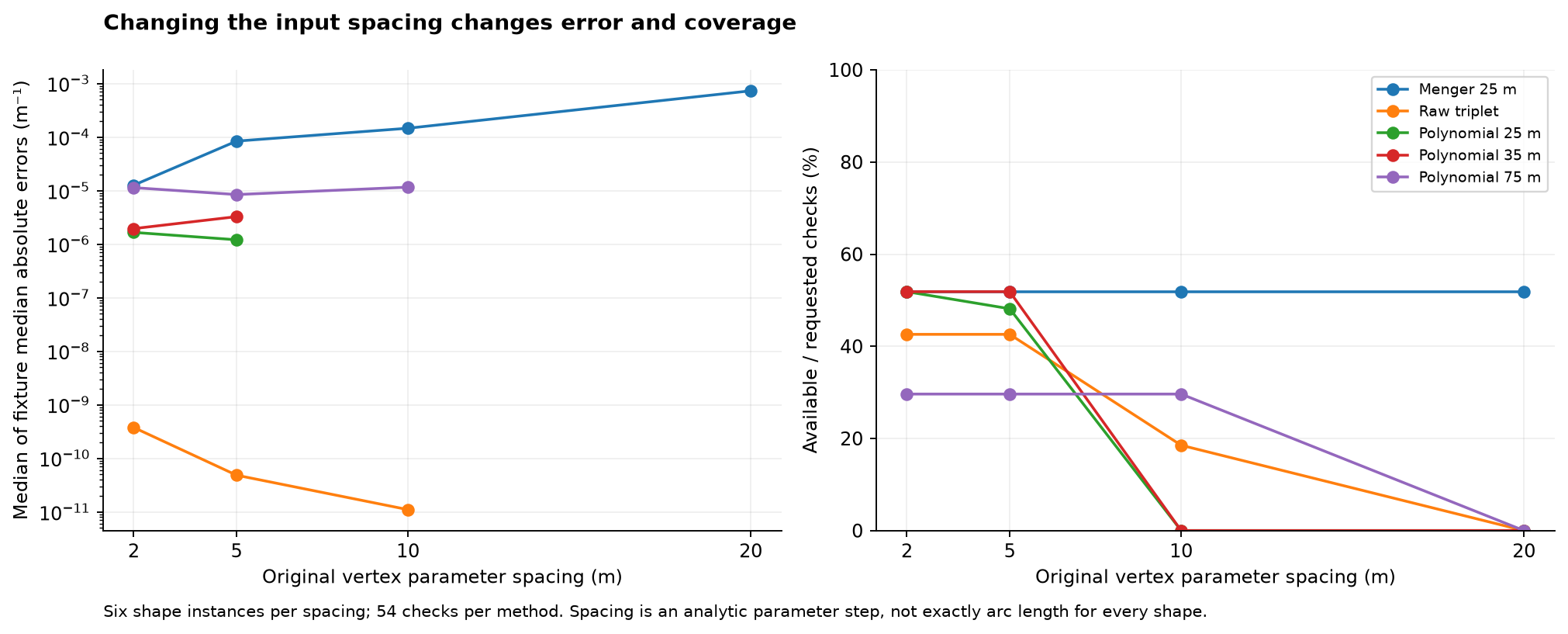
What Changes When Mapped Points Are Farther Apart?

The same curve sampled at two spacingsTwo equal-scale diagrams show the same 47 metre radius circular arc. The dashed reference is smooth. Increasing the spacing from five to twenty metres replaces several short chords with longer straight chords.5 m spacing20 m spacingIllustration · same 47 m radius circle, equal scales. Dots are sampled vertices.
Typical relative error · scale 0 to 60%
SpacingErrorAvailable
2 m0.41%28/54
5 m2.67%28/54
10 m3.56%28/54
20 m59.56%28/54

6 synthetic fixtures per spacing. Neighbouring stations share geometry.

Error increased with spacing on these shapes. The chart takes the median error within each fixture, then the median across fixtures. Spacing here is a step in the curve parameter. Relative error excludes unavailable and near-zero reference values. Original multi-method plot

A Success and a Failure

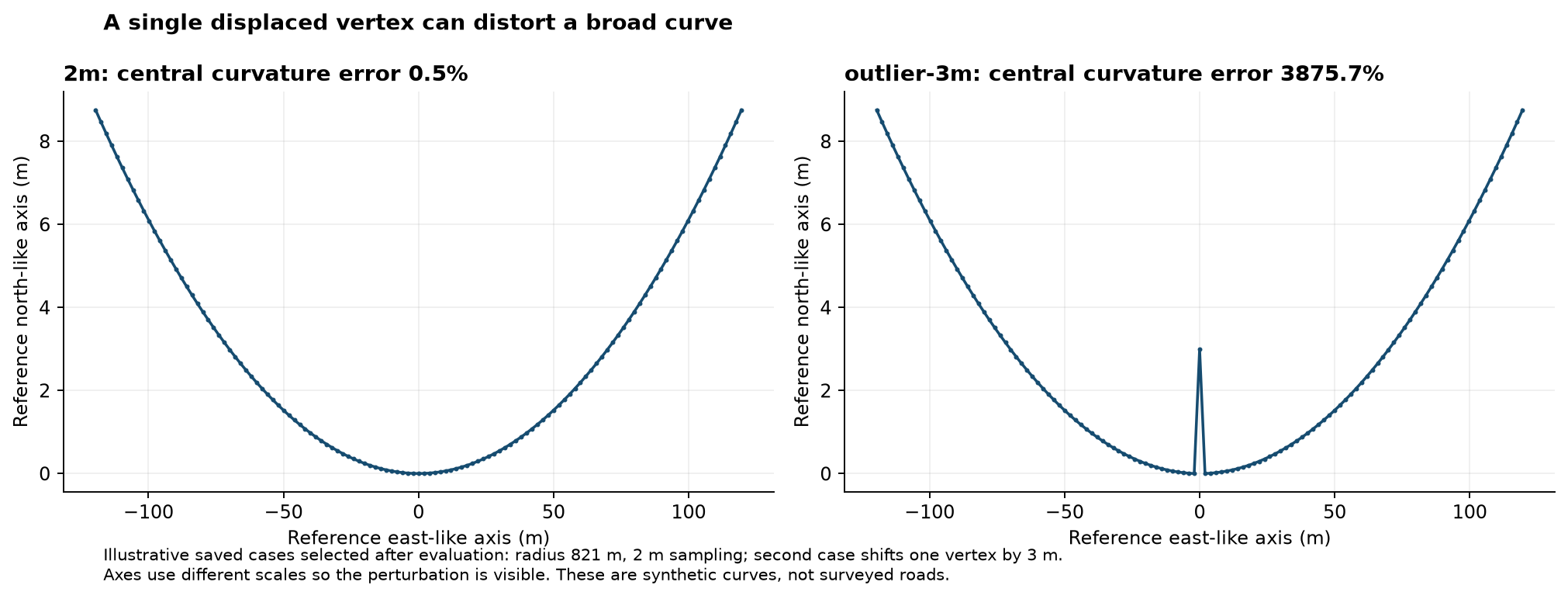
These saved examples were selected after evaluation to explain the result. One vertex displaced by 3 metres strongly distorts the central estimate on a broad, 821-metre-radius curve. The axes have different scales.
Open full-size figure

What This Establishes, and What It Leaves Open

  • It measures numerical behaviour against analytic curvature through the geographic input path. It does not measure the accuracy of OpenStreetMap against a surveyed alignment.
  • Noise sizes and fixture frequencies are deliberate stress tests. The 44.7% availability is not an estimate of coverage across Ireland.
  • Signed curvature errors can be large on perturbed broad curves. A turning-direction failure and a radius error are different diagnostics.
  • The real-road extension uses 25 windows from eight original ways in two corridors. It describes stability and ordering; it is neither independent road truth nor collision validation.
  • A surveyed reference sample, documented uncertainty and external specialist review remain needed. No safe-driving recommendation follows from these figures.

The work was implemented and analysed with AI coding assistance. The project’s personal contribution and mentoring record remains on Authorship; this experiment does not add an unverified claim of personal work or external approval.

Reproduction Record

Study geographic-holdout-2026-11-18-v1. The source pack contains the frozen protocol, generator, all 7,560 result cells, failure reasons, inputs and execution receipts. Reproduction compared every output byte. The supplementary matched-population comparison is explicitly exploratory.

Evidence file identities
Held-out summary SHA-256
9c9c120482344002ba7e58e82aee1a0556dcb7981b6ffe298a8e365dfcff5bc5
Held-out matrix SHA-256
f3309eb3960b3ef46d2b26a55290f1d93b41086a081e7a1b3d2c98a9312d5495
Frozen protocol/source lock SHA-256
76eac40290cec243554a25af3201745d1e9ecbb37a61be45195ea06a41f644f4